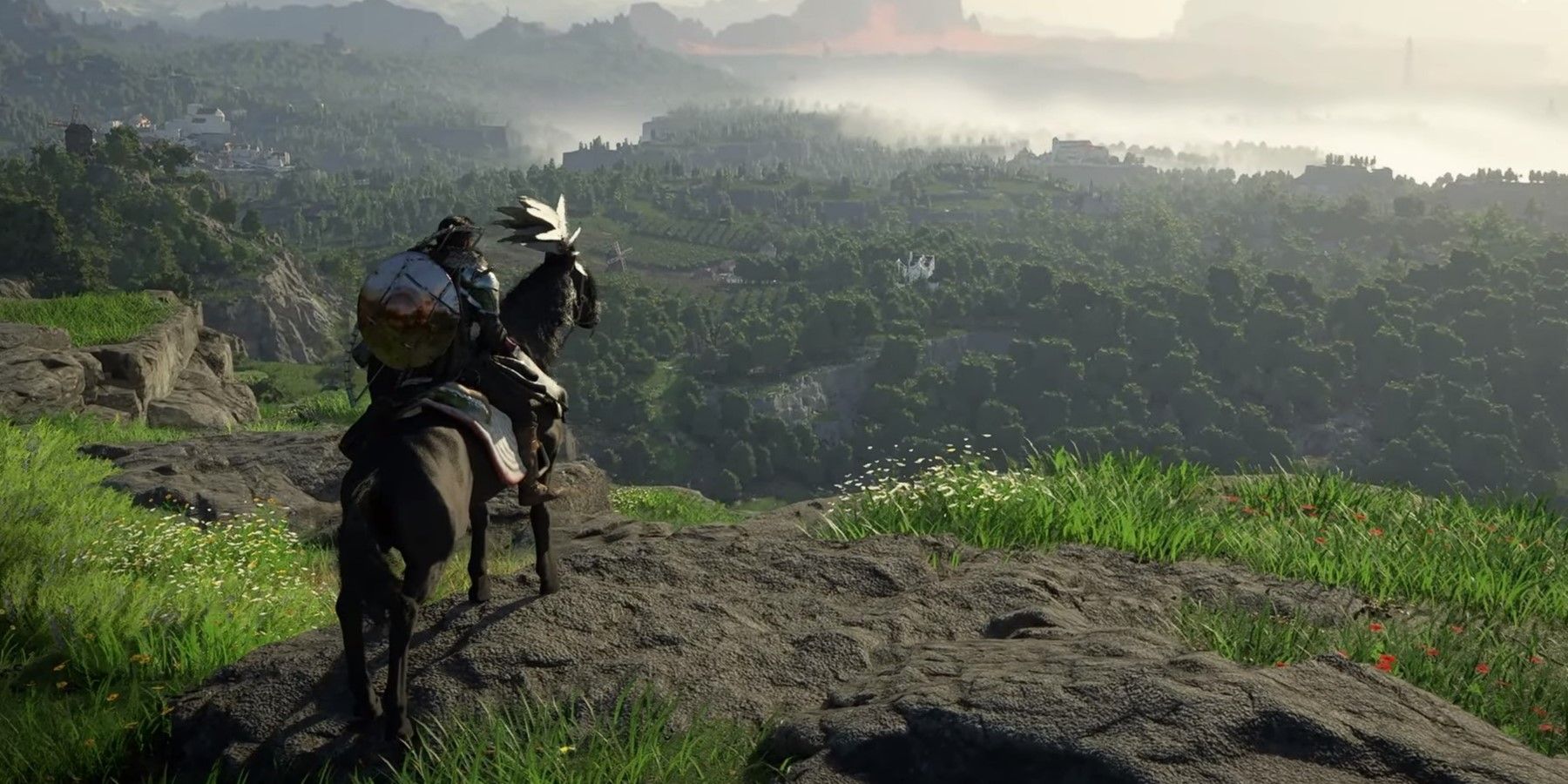
Crimson Desert is an ambitious project from the South Korean developer Pearl Abyss, widely recognized for its work on Black Desert Online. Positioned as an open-world action RPG, the title has attracted significant attention due to its advanced technology, cinematic presentation, and emphasis on a dynamic, story-driven experience. Rather than focusing solely on traditional role-playing mechanics, Crimson Desert integrates narrative depth, real-time combat systems, and large-scale environmental simulation into a cohesive framework.
A World Defined by Conflict and Survival
Crimson Desert takes place on the continent of Pywel, a harsh and politically unstable land shaped by war, shifting alliances, and social unrest. Players assume the role of Macduff, the leader of a mercenary group known as the Greymanes. The narrative follows his journey through a fractured world, where survival is tied closely to leadership, loyalty, and the consequences of difficult decisions.
The storytelling approach is character-driven, emphasizing personal struggles alongside broader geopolitical tensions. Instead of relying on a strictly linear structure, the game introduces branching elements and situational storytelling. Events unfold dynamically, allowing players to experience both central plotlines and side narratives that expand the world’s lore. This design encourages exploration not just of geography, but of relationships and motivations within the game’s universe.
Proprietary Engine and Technological Framework
A core pillar of Crimson Desert is its proprietary technology, built on Pearl Abyss’ internally developed BlackSpace Engine. This engine is designed to support expansive, seamless environments with high levels of detail and interactivity.
The rendering system enables real-time lighting, advanced particle effects, and physically based rendering techniques. Combined with large-scale terrain streaming, the engine allows players to traverse vast regions without noticeable loading interruptions. Environments range from mountainous regions and frozen landscapes to dense forests and arid deserts, each rendered with distinct atmospheric conditions.
Physics simulation plays a central role in the experience. Environmental objects respond dynamically to player input, and structural elements can be affected or destroyed under certain conditions. These systems are integrated into gameplay, influencing both traversal and combat scenarios.
Combat System Design and Mechanics
The combat system in Crimson Desert is built to merge accessibility with mechanical depth. It incorporates melee combat, ranged attacks, and special abilities into a unified system that emphasizes timing, positioning, and adaptability.
Players can chain attacks, perform counters, and utilize environmental interactions during combat. Grappling mechanics allow for advanced maneuvers, including pulling enemies closer, redirecting their momentum, or using them strategically within the environment.
Enemy AI is designed to react dynamically to player behavior. Opponents adjust tactics based on distance, aggression, and environmental factors, contributing to encounters that vary in structure and pacing. This approach aims to move beyond scripted combat patterns toward more emergent gameplay.
Exploration and Environmental Interaction
Exploration is a foundational component of Crimson Desert’s design. The world of Pywel is populated with dynamic events, hidden locations, and activity systems that extend beyond the main narrative.
Players can engage in a range of activities, including hunting, gathering, and participating in large-scale conflicts. Movement across the environment is supported by multiple traversal systems, such as horseback riding, climbing, and contextual interactions with terrain.
Non-playable characters (NPCs) operate within simulated routines, responding to both time-of-day cycles and player actions. This creates a more reactive world, where interactions can influence relationships, availability of quests, and broader environmental states.
Dynamic Weather and Time Systems
The game features a fully dynamic weather system that affects both visual presentation and gameplay conditions. Rain, snow, wind, and fog are simulated in real time, influencing visibility, movement, and combat effectiveness.
The day and night cycle further enhances immersion. Certain enemies, missions, and environmental behaviors are tied to specific times of day. NPC schedules shift accordingly, reinforcing the sense of a living world governed by consistent internal logic.
Hybrid Multiplayer Integration
While primarily structured as a single-player experience, Crimson Desert includes selective multiplayer elements. These features are designed to integrate seamlessly into the broader world without disrupting narrative continuity.
Players may encounter cooperative opportunities or competitive scenarios embedded within the environment. This hybrid approach allows for social interaction while maintaining the integrity of the story-driven framework.
Progression Systems and Character Development
Character progression in Crimson Desert is based on a combination of skill development, equipment upgrades, and narrative choices. As players progress, they unlock new abilities and refine combat techniques that align with their preferred playstyle.
Equipment systems provide additional layers of customization. Weapons and armor offer varying attributes and enhancements, while crafting and resource management enable players to modify or improve their gear. These systems are interconnected, encouraging long-term progression and strategic planning.
Cinematic Presentation and Audio Design
Crimson Desert adopts a cinematic approach to storytelling, blending gameplay with high-quality cutscenes and performance capture. Transitions between interactive and non-interactive sequences are designed to be seamless, preserving immersion.
The audio design complements the visual presentation through adaptive music and detailed sound effects. The soundtrack responds to gameplay intensity, while environmental audio reinforces the realism of different regions and conditions.
Platform Optimization and Technical Accessibility
The game is being developed for modern platforms, including PC and contemporary consoles. It is optimized to leverage advanced hardware capabilities such as high-resolution rendering, ray tracing, and enhanced performance scaling.
Accessibility features are also part of the design framework. Players are provided with options to adjust control schemes, difficulty levels, and visual settings, making the experience more adaptable to different user preferences and needs.
A Synthesis of Technology and Design
Crimson Desert represents a convergence of advanced engine technology and narrative-focused design. By combining large-scale environmental simulation, responsive combat systems, and character-driven storytelling, the game aims to deliver a comprehensive interactive experience.
The project reflects broader trends in the gaming industry, where technical innovation is increasingly aligned with immersive storytelling. Through its integration of physics systems, AI behavior, and real-time environmental changes, Crimson Desert illustrates how modern game development continues to evolve toward more complex and dynamic virtual worlds.
As development progresses, the title stands as an example of how proprietary technology and design ambition can be combined to push the boundaries of what is achievable in contemporary interactive entertainment.